The Port They Cannot Read:Puerto Chancay, Chinese Strategic Infrastructure, and the Civilisational Grammar of Hemispheric Influence
Abstract
The November 2024 inauguration of Puerto Chancay in Peru; the first deep-water megaport on South America's Pacific coast built and operated by a Chinese state-owned enterprise, has been widely treated in Western policy commentary as a significant but primarily commercial development. This article argues that such characterisations reflect precisely the failure of a persistent Western incapacity to read Chinese strategic action through the temporal and civilisational grammar from which it actually emerges. Drawing on primary Chinese-language sources, the strategic theory of shi as developed in the classical tradition, and the historical architecture of the Century of Humiliation, the article contends that Chancay is best understood not as a port but as a node in a system of infrastructure-as-influence designed to accumulate strategic potential (shi) in the Western Hemisphere on a civilisational timeline anchored to the 2049 centenary horizon. Against this, the article examines the structural liabilities of the American relationship with Latin America; rooted in the extractive logic of the Monroe Doctrine and the disciplinary economics of the Washington Consensus, that have created the trust deficit China is now exploiting with considerable skill. The article concludes that serious Western policy analysis of Chinese engagement in the Americas requires the same reorientation toward primary sources and civilisational temporality argued for in the companion piece, applied now to the hemisphere Washington has historically treated as a colony and Beijing is systematically courting as a partner.
PROLOGUE: A PORT THEY CANNOT READ
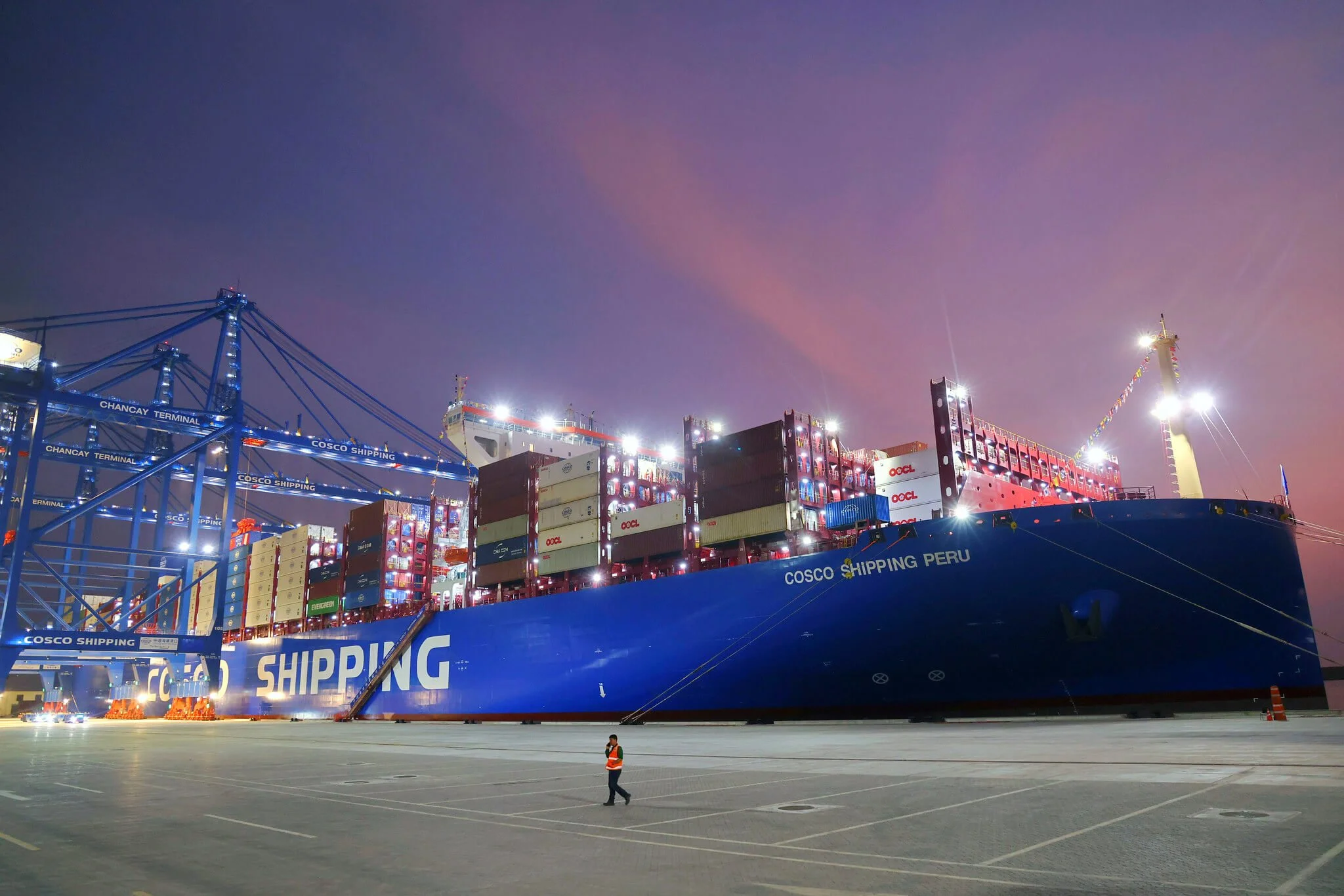
On 14 November 2024, the container ship COSCO Shipping Denali glided into the newly completed berths of Puerto Chancay, eighty kilometres north of Lima, Peru, and became the first ultra-large vessel to call at a facility that COSCO Shipping Ports Limited had spent the better part of a decade and $3.5 billion constructing on South America's Pacific coast.[1] President Xi Jinping attended the inauguration by video link. The Peruvian government declared the port a site of national strategic importance.[2] Western commentary, broadly, noted the commercial significance and expressed the familiar concerns about Chinese influence in the region; debt diplomacy, dual-use infrastructure, strategic encirclement, before moving on.
What Western commentary did not do, for the most part, was read Chancay the way it must be read to be understood: as an expression of civilisational time operating on a horizon incomprehensible to the electoral temporality of Western strategic culture.[3] In my companion piece to this article, "The Clock They Cannot Read," I argued at length that the deepest failure of Western China analysis is not one of intelligence or rigour within its own framework, but of the framework itself; a persistent mirror-imaging that projects Western temporal assumptions onto a civilisation-state operating from a fundamentally different conception of strategy, patience, and historical destiny. The argument of the present article is that the same failure, applied now to the Western Hemisphere, has left American policymakers and their analytical apparatus consistently one cognitive step behind a Chinese engagement strategy whose logic is, in fact, clearly legible, provided one knows how to read it.
Chancay is not a port. It is a character in a sentence that Beijing began writing in 2013 and intends to complete by 2049; the centenary of the People's Republic and the declared horizon of the "Great Rejuvenation of the Chinese Nation."[4] To read it as merely commercial infrastructure is to make the same category error as reading a BRI memorandum of understanding as merely a trade agreement, or reading a Qiushi editorial as merely a political speech. The grammar is different. The temporality is different. The strategic intelligence required to interpret it is, as yet, largely absent from the mainstream of Western hemispheric policy.
PART I: INFRASTRUCTURE AS CIVILISATIONAL GRAMMAR
The Belt and Road Initiative (BRI), launched in 2013, is frequently misread in Western commentary as either an economically motivated infrastructure programme that happens to generate geopolitical side effects, or as a geopolitical strategy cynically disguised as economic development. Both framings miss the essential point.[5] The BRI is most accurately understood as the material expression of a civilisational project; the creation of a global infrastructure network whose nodes and arteries are systematically positioned to maximise Chinese strategic potential over a multi-decade horizon, operated through state-directed enterprises answerable ultimately to Party authority rather than market logic.
COSCO Shipping Ports, the operator of Chancay, is not a private company that happens to have a Chinese owner and Chinese state backing. It is a subsidiary of China COSCO Shipping Corporation Limited, one of the world's largest shipping conglomerates and a central state-owned enterprise (SOE) under the direct supervision of SASAC; the State-owned Assets Supervision and Administration Commission of the State Council.[6] The legal obligations of Chinese SOEs to advance national strategic interests, codified in statute and elaborated in internal Party guidance, mean that the distinction between commercial and strategic imperatives that Western analysts apply to Chancay's operations is, from a Chinese governance perspective, a false one. The port is both. It is designed to be both.
This is infrastructure as civilisational grammar; the encoding of Chinese strategic intent into the physical landscape of a continent. BRI ports, railways, digital networks, and special economic zones do not merely facilitate trade; they establish the material conditions under which Chinese standards, Chinese logistics systems, Chinese financial instruments, and ultimately Chinese political norms become structurally embedded in partner economies.[7] Chancay, specifically, is designed to become the hub through which the agricultural and mineral output of an entire continent flows to Chinese markets, and through which Chinese manufactured goods return. The party that controls the hub controls, to a significant degree, the terms on which commerce occurs and the political dependencies that commerce creates.
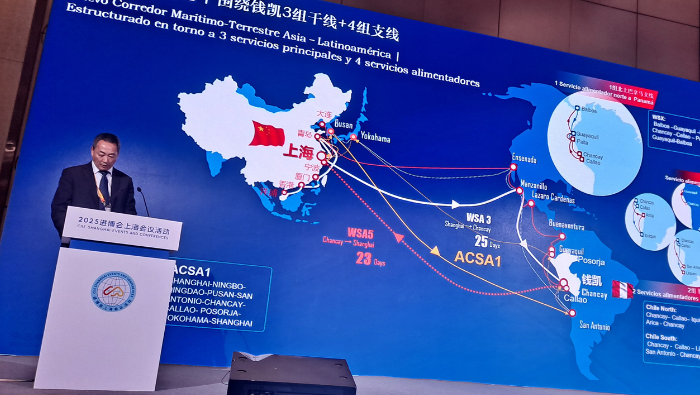
The trans-South American corridor ambition linked to Chancay extends this logic to its logical conclusion. Feasibility studies for rail links connecting Brazil's interior; its soy belts, its iron ore deposits, its industrial heartland to the Peruvian Pacific coast via Chancay's berths would, if realised, create an infrastructure artery along which COSCO tankers and Chinese logistics companies move the commodity wealth of a continent to Shanghai and Shenzhen.[8] This is not an aspiration. It is a doctrinal priority. And it operates on the 2049 timeline that "The Clock They Cannot Read" identified as the master horizon against which every significant Chinese strategic decision is being calibrated.
PART II: THE SHI OF THE PACIFIC — STRATEGIC CONFIGURATION AND PUERTO CHANCAY
As I have discussed previously, the classical Chinese strategic concept of shi (勢); typically rendered as strategic configuration, potential, or situational advantage is the key analytical instrument for understanding what Chancay represents in Beijing's hemispheric calculus.[9] In the companion piece to this article, the concept is introduced in the context of Taiwan and the PLA's force development. Applied to the Western Hemisphere, it illuminates a strategic logic that Western analysts focused on capability timelines and specific threat scenarios consistently fail to perceive.
Sun Tzu's supreme strategic achievement is not to win the decisive battle. It is to shape the environment; to accumulate advantages, to manage configurations of power and dependency, so that when engagement becomes necessary, its outcome is already determined.[10] The skilled strategist, in classical formulation, acts only when the shi; the propensity of the situation, is already moving in the desired direction. The decisive action is not the beginning of the strategic process; it is the culmination of patient preparation.
Applied to Chinese engagement in the Western Hemisphere, Chancay is an act of shi accumulation; the building of a structural advantage whose full strategic weight will not be apparent until the configuration has matured. Consider what the port creates: a deep-water Pacific hub operated by a Chinese SOE, normalising the Chinese logistics and financial presence on South America's Pacific coast; a physical infrastructure that gives Chinese vessels preferential berth access and Chinese customs officials familiarity with regional commodity flows; an economic dependency for the Peruvian government (which has staked significant political capital on Chancay's success) that creates structural incentives for Lima to manage its relationship with Beijing carefully.[11]
These are not dramatic power-political moves. They are the patient accumulation of positional advantage; the creation of a situation in which, at some future moment of geopolitical consequence, Chinese interests in the Western Hemisphere will be structurally embedded in a way that makes their disruption costly not just for China but for the Latin American governments and populations that have come to depend on the infrastructure China built. This is shi as strategic method. And it is virtually invisible to an analytical framework that focuses on military capability timelines and short-cycle political decisions.
The lithium dimension compounds this logic significantly. Chile, Argentina, and Bolivia collectively hold the preponderant share of global lithium resources; the foundational input for the electric vehicle revolution that is reshaping global energy and industrial geopolitics.[12] Chinese companies have been systematically acquiring processing contracts, minority and majority equity stakes in mining operations, and logistics influence over the supply chain that moves this material from Andean extraction points to industrial processors.[13] A Chinese-operated deep-water port on the Pacific coast of South America is the logistical complement to these upstream investments; the facility through which the output of Chinese-influenced mines will most efficiently reach Chinese processing plants. The configuration, when complete, gives Beijing a structural position in the global clean energy supply chain that no amount of American political rhetoric about supply chain resilience will easily dislodge.
PART III: THE CENTURY OF HUMILIATION GOES TO SEA
Rejuvenation as Reversal
In "The Clock They Cannot Read," I argued that the bainian guochi; the Century of Humiliation running from the First Opium War to the founding of the People's Republic is not a historical grievance in the Western political sense but "the foundational architectural element of the CCP's claim to legitimacy."[14] It shapes every significant Chinese foreign policy decision as both wound and compass: wound, because the memory of civilisational degradation is maintained as an active political resource; compass, because the correction of that degradation; the restoration of Chinese centrality, is the organising purpose of the current epoch.
The Belt and Road Initiative, and Chancay specifically, can only be fully understood within this framework. The nineteenth and early twentieth centuries saw Western powers and Japan extract China's resources and markets through military coercion, unequal treaties, and the forced opening of treaty ports; concession zones on Chinese soil where foreign powers exercised sovereignty.[15] What the CCP is now doing in the Western Hemisphere is, from one perspective, the mirror image of what was done to China during those decades: building infrastructure, creating economic dependencies, operating concession-like zones within host country territory; but framed, and in important respects genuinely experienced by many recipient countries, as partnership and development rather than extraction and coercion.
The Special Economic Zone status of Chancay; which grants COSCO Shipping operational and regulatory privileges within Peruvian national territory[16], echoes, structurally if not in its exploitative character, the treaty port system that China was forced to accept in the nineteenth century. The difference, and it is significant, is that Peru entered this arrangement voluntarily, in pursuit of economic development goals, and retains formal sovereignty. The symmetry is not perfect. But the civilisational resonance; China now the architect of such zones rather than their subject, is not lost on Chinese strategists or, one suspects, on Xi Jinping himself.
Infrastructure as Tributary Reversal
The historical tributary system through which China organised its relationships with peripheral states across East and Southeast Asia established Chinese civilisation as the normative centre of a hierarchical regional order.[17] Peripheral rulers sent missions to the Chinese court, acknowledging symbolic subordination in exchange for trade privileges and the legitimating imprimatur of Chinese recognition. This system was not primarily about extraction, though it generated economic benefits for both parties; it was about the projection of civilisational centrality.
The BRI represents what might be called a tributary reversal; a reconfiguration of global infrastructure flows that positions China once again as the civilisational and logistical centre, but achieved now through economic means rather than cultural prestige, and extended to a global rather than merely regional scale.[18] Where the historic tributary system attracted peripheral states to the Chinese court through the gravitational pull of Chinese cultural and economic superiority, the BRI extends Chinese infrastructure outward; to Africa, Central Asia, Southeast Asia, and now Latin America, creating dependency relationships that flow inward toward Chinese commodity importers, Chinese financial institutions, and Chinese political frameworks.
Chancay is the Western Hemisphere node of this reversal. Its function is to orient the commodity wealth of South America's Pacific coast toward Chinese markets along infrastructure that Chinese companies own and operate, on terms that Chinese financial institutions have partly structured, within a political framework that Chinese diplomatic engagement has cultivated across two decades of patient relationship-building. This is not hegemony in the Americano-Clausewitzian sense; maintained through military presence and coercive capacity. It is hegemony as the classical Chinese tradition understood it: the natural deference that accrues to the power that has made itself indispensable.[19]
PART IV: THE MONROE DOCTRINE AS COLONIAL ARCHITECTURE — AND ITS STRATEGIC LEGACY
The Hemisphere as Managed Territory
The contrast between Chinese and American strategic cultures in Latin America is, at its most fundamental level, a contrast between two theories of how great powers relate to smaller states. The American theory, as practised across nearly two centuries of hemispheric engagement, has been a theory of managed territory; the maintenance of a sphere of dominance in which smaller states retain formal sovereignty but exercise it within constraints defined by Washington's strategic and economic interests.[20]
The Monroe Doctrine of 1823 began as a reasonable assertion that the Western Hemisphere should not be subject to renewed European colonial settlement. It metastasised, through the Roosevelt Corollary, the Cold War security framework, and successive U.S. administrations' interventionist practice, into a comprehensive claim to hegemonic management of the region.[21] The consequences are well-documented and, in the region itself, well-remembered: the overthrow of Guatemala's democratically elected government in 1954, the support for Pinochet's coup against Allende in 1973, the backing of military dictatorships across Central America in the 1980s, repeated coercive economic pressure, and the imposition, through the Washington Consensus and IMF conditionality, of economic prescriptions that generated inequality and social dislocation across the region.
The Washington Consensus — the package of macroeconomic policies promoted by the U.S. Treasury, the IMF, and the World Bank from the late 1980s through the early 2000s — dismantled state-directed development models, privatised public enterprises (often to the benefit of transnational capital rather than domestic populations), liberalised capital accounts in ways that proved catastrophically destabilising in the 1990s crises in Mexico, Brazil, and Argentina, and produced a generation of stagnant growth combined with rising inequality across much of the region.[22] The political consequences were significant and durable: the "Pink Tide" of leftward electoral shifts beginning in 1998 drew directly on popular resentment of these policies and of the American power that had promoted them.[23]
The Trust Deficit and Its Strategic Exploitation
The critical geopolitical consequence of this history is a trust deficit of extraordinary depth. When the United States warns Latin American governments about Chinese investment; about debt dependency, dual-use infrastructure, sovereignty erosion, those warnings are received by governments and publics who have experienced American debt traps (the IMF conditional lending of the Washington Consensus period), American sovereignty violations (the intervention record), and American infrastructure investment that extracted resources for American corporate benefit.
The messenger is comprehensively compromised. And China has proved remarkably adept at exploiting this fact.[24] Chinese diplomatic engagement in Latin America systematically positions Beijing as the anti-colonial partner; the power that offers investment without political conditions, infrastructure without ideology, and economic relationships premised on mutual benefit rather than great-power management. The "non-interference in internal affairs" principle, which Western critics rightly identify as a mechanism that insulates authoritarian governments from accountability pressure, is experienced by many Latin American leaders as respect for sovereignty in a way that American engagement, historically, has not been.
This is not to argue that Chinese engagement is without its own forms of conditionality and leverage.[25] Chinese lending has generated genuine debt vulnerabilities in Ecuador and elsewhere. Labour practices at Chinese-operated facilities in Peru and across the Global South have generated local opposition. The "non-interference" principle protects some genuinely predatory governments. The BRI has its own structural asymmetries; China captures the high-value engineering and financing components of infrastructure projects while local workforces frequently obtain lower-skilled labour and residual employment.[26] But these structural problems are real and acknowledged in the receiving country; what they do not do is override the fundamental perception that China shows up, builds things, and does not lecture.
PART V: TWO MODELS OF HEMISPHERIC TIME
Electoral Temporality and Its Hemispheric Consequences
In "The Clock They Cannot Read," I argued that Western strategic culture operates within what may be called "electoral temporality"; a rhythm of decision-making shaped by four- and five-year political cycles, quarterly economic reporting, and the perpetual news present.[27] Applied to the Western Hemisphere, this temporal structure produces a consistent pattern: ambitious U.S. initiatives toward Latin America, announced with rhetorical fanfare at the beginning of administrations, progressively defunded, deprioritised, or quietly abandoned as domestic political pressures reassert themselves and the electoral cycle shortens the horizon of political calculation.
The Americas Partnership for Economic Prosperity, the Partnership for Global Infrastructure and Investment, the Summit of the Americas process; each generation of American administrations has produced its own version of this pattern.[28] Grand commitments to infrastructure investment, economic partnership, and democratic solidarity are made in the knowledge that Congress must fund them, that domestic political constituencies have higher electoral salience than Latin American relationships, and that the next administration may reorient entirely. In concrete deliverables, PGII had committed approximately $4 billion in confirmed Latin American projects by mid-2024, against Chinese infrastructure investment in the region averaging $14.5 billion annually across the preceding five years.[29]
The contrast is not primarily one of resources, though American resources are obviously sufficient to be more competitive if directed toward the region. It is one of strategic temporality. China's engagement with Latin America is calibrated to a 2049 horizon. The BRI documents that guide it were drafted through a process of extraordinary bureaucratic care and interagency coordination, designed to survive changes in personnel and to accumulate advantages across decades.[30] American engagement with the region is calibrated to the next election. The structural asymmetry is as significant as any specific policy difference.
China's Civilisational Patience and the Latin American Long Game
The tao guang yang hui doctrine; hide your strength, bide your time, that Deng Xiaoping articulated in the immediate aftermath of Tiananmen was the appropriate posture for a China that was economically modest, diplomatically isolated, and militarily limited.[31] The transition to Xi's more assertive posture, theorised ahead of its time by scholars like Yan Xuetong, reflects a genuine assessment that China's accumulated shi has grown sufficiently to support a more direct expression of interests.[32] But the patience embedded in the Dengist doctrine was not discarded when the posture changed. It was transmuted “from the patience of concealment to the patience of systematic construction”.
In Latin America, this transmuted patience is visible in the two-decade arc of Chinese engagement. From the early 2000s, when China was a minor trading partner for most of the region, to 2024, when China is the dominant trading partner for most of South America, Chinese engagement followed a consistent logic: establish trade relationships, scale them through commodity purchasing that gives partner economies genuine economic incentives for the relationship, then deepen it through financial engagement, infrastructure investment, people-to-people exchange, and institutional relationship-building.[33] The COVID vaccine diplomacy of 2020–2021 was a particularly well-executed expression of this logic; China providing vaccines before Western suppliers could deliver at scale, generating goodwill across the region at a moment of genuine vulnerability.[34]
Chancay is the infrastructure culmination of this two-decade accumulation. It did not appear suddenly as an act of Chinese strategic adventurism. It was the predictable endpoint of a strategic trajectory that was, in fact, legible throughout its development to anyone reading the primary Chinese sources as systematically underanalysed in Western policy circles.[35]
PART VI: READING THE BRI AS A PRIMARY SOURCE
A methodological argument runs through both this article and its companion piece: that the analytical failure of Western China studies is not merely conceptual but sourcing. Western policy analysts consistently underread the primary Chinese documents; Qiushi, the National Party Congress reports, Xi's collected speeches, the BRI founding documents, in which Chinese strategic intent is plainly, if allusively, stated.
The March 2015 document "Vision and Actions on Jointly Building Silk Road Economic Belt and 21st-Century Maritime Silk Road," co-issued by China's NDRC, Ministry of Foreign Affairs, and Ministry of Commerce, is the foundational BRI text.[36] Its five pillars — policy coordination, facilities connectivity, unimpeded trade, financial integration, and people-to-people bonds — are listed in an order that is not alphabetical, not rhetorical, and not accidental. Policy coordination comes first because it is the precondition for everything else: the alignment of partner-country regulatory environments, governance frameworks, and ultimately political orientations with Chinese preferences. Infrastructure is the means; political influence is the object.
Applied to Latin America, this framework reveals the strategic logic of China's regional engagement in a way that the commercial framing consistently obscures. The Chinese goal is not simply to buy South American soybeans and Peruvian copper. It is to create the conditions; through infrastructure ownership, financial dependence, trade reliance, and political relationship-building, in which Latin American governments find it structurally advantageous to align their policy positions with Chinese preferences on questions of international governance, technology standards, and, ultimately, the management of Taiwan and the South China Sea.[37]
Xi's 2023 address to the Third Belt and Road Forum introduced the language of "system integration" (体系整合) as the goal of the BRI's next phase; a phrase that signals the transition from project-by-project engagement to the structural embedding of Chinese systems, standards, and norms into partner economies.[38] In the Western Hemisphere, Chancay represents the arrival of this phase. It is not one Chinese investment project among many. It is an anchor infrastructure node from which system integration; of logistics standards, of financial instruments, of regulatory frameworks, of digital infrastructure, can proceed.
PART VII: THE LEGALIST CALCULUS OF STATE-DIRECTED ENTERPRISE
"The Clock They Cannot Read" I argued that Xi's governance practice is "deeply Legalist in its structure" and that this matters because it means "Chinese decision-making at the highest levels is far more coldly instrumental than either the emotional nationalist narrative or the harmony-seeking Confucian narrative would suggest."[39] This cold instrumentality is directly relevant to understanding how COSCO Shipping Ports' operation of Chancay should be assessed by Western strategists.
The Legalist tradition holds that the ruler's authority depends on maintaining informational advantage over subordinates, that the system of rewards and punishments must operate with predictable clarity, and that institutional structures should be designed to prevent any subordinate accumulating independent authority.[40] Applied to the governance of SOEs like COSCO, this means that the relationship between commercial operation and strategic purpose is not mediated by the market logic that Western analysts assume governs corporate behaviour. The leadership of COSCO does not face a trade-off between commercial profitability and strategic service to Party goals. Serving Party strategic goals is the metric on which they are evaluated, alongside commercial performance — and when the two conflict, there is no ambiguity about which takes precedence.
The dual-use potential of Chancay must be understood within this framework. The berths at Chancay are designed to accommodate ultra-large container vessels. Those same berths can accommodate naval auxiliaries. The data flows through the port's management systems; tracking commodity volumes, shipping schedules, vessel movements, constitute a form of maritime domain awareness that has obvious value to Chinese state intelligence apparatus.[41] This does not mean Chancay is primarily a military facility. It means that the commercial and strategic functions are integrated in a way that Chinese governance structures are designed to exploit and that Western corporate governance models do not replicate.
Western strategic analysts who focus on the question "is Chancay a military threat?" are asking the wrong question; the same error as the Taiwan analysts who ask "when will China have the military capability to invade?" The more important question is: what does Chancay's existence do to the strategic environment of the Western Hemisphere over the next decade? The answer; that it normalises Chinese SOE operation of critical Pacific infrastructure, deepens commodity dependency relationships, and gives Beijing informational and logistical presence in a hemisphere Washington has historically regarded as its exclusive domain, is a more significant strategic development than any specific military threat assessment.
PART VIII: LATIN AMERICAN AGENCY AND THE LIMITS OF GREAT-POWER FRAMING
Any serious analysis of the geopolitics of Chancay must resist the temptation to frame Latin American nations as passive objects of great-power competition. The region's long experience of being managed, coerced, and instrumentalised by outside powers has produced a sophisticated tradition of strategic autonomy thinking; the consistent assertion, across very different ideological governments, of the right to hedge between great powers and to use external interest in the region as leverage for national development goals.[42]
Peru did not simply receive Chancay as a gift from Beijing. Peruvian governments across several electoral cycles made a deliberate decision to grant the port concession to COSCO, to designate Chancay a Special Economic Zone, and to frame the port as a national development priority. The calculation is rational from a Peruvian perspective: Chancay diversifies Peru's infrastructure and export logistics dependence, gives Lima a new card in its relationships with both China and the United States, and delivers genuine development infrastructure that no other partner was offering to build.[43] The Biden administration's response; concern expressed through diplomatic channels, vague alternative investment proposals, illustrates the broader American failure: the offer arrived after the Chinese shovel, when the structural fact of Chancay was already creating path dependencies.
Similar calculations are visible across the region. Brazil, under governments ranging from Bolsonaro's right-wing nationalism to Lula's left-wing developmentalism, has maintained China as its top trading partner and continued engagement with Chinese investment while simultaneously maintaining security relationships with the United States. Chile, perhaps the region's most institutionally sophisticated economy, has pursued Chinese copper export relationships, lithium sector engagement, and Huawei 5G infrastructure while maintaining its commitment to democratic governance and its historical alignment with Western international institutions.[44]
The sophistication of Latin American hedging should be read not as a failure of American influence but as evidence of a regional strategic culture that will not easily be organised into either the American or Chinese camp. This creates both a challenge and an opportunity for Western policymakers: if Latin American nations are genuinely hedging rather than drifting into Chinese dependency, there remains space for American re-engagement on terms that do not require Latin American governments to choose between economic relationships with China and political relationships with the United States.[45] But that re-engagement requires the United States to offer something concrete; infrastructure financing, genuine trade openness, sustained diplomatic respect, rather than warnings about Chinese behaviour delivered without accompanying positive vision.
PART IX: WHAT SERIOUS HEMISPHERIC ANALYSIS WOULD LOOK LIKE
In "The Clock They Cannot Read," I outlined what serious analysis of Chinese strategic intent would require: systematic engagement with primary Chinese-language sources, reading of Qiushi as doctrinal signal rather than propaganda, treatment of National Party Congress resolutions as policy architecture rather than political theatre, and the analytical humility to recognise that strategic timelines operating on civilisational horizons are not commensurable with the prediction timelines of Western think-tank output.[46] Applied to the Western Hemisphere, this methodology yields a different analytical picture than the one that dominates current policy discourse.
Reading BRI founding documents, Xi's speeches to the Third Belt and Road Forum, and the specific diplomatic language with which China characterises its relationships with key Latin American partners; "comprehensive strategic partnership" designations reserved for the most important bilateral relationships, one can trace a clear arc of Chinese strategic intent in the region.[47] The goal is not military preponderance. It is structural indispensability: the creation of economic, infrastructure, and institutional relationships in which Latin American governments find it costly to oppose Chinese interests on questions of international governance, and in which Chinese logistical and informational presence in the hemisphere is normalised and entrenched before the United States mobilises a serious competitive response.
Serious analysis would also require an honest accounting of American structural liabilities in the region; not as a counsel of despair but as a prerequisite for meaningful reform of American hemispheric strategy. The Washington Consensus decade discredited American economic advice across Latin America in a way that Chinese investment is now exploiting.[48] American warnings about Chinese debt diplomacy land in countries that experienced American-prescribed debt traps. American appeals to democratic solidarity land in governments that remember American support for the military dictatorships of the 1970s and 1980s. The credibility deficit is real, deep, and not easily remediated by rhetorical commitments, however sincere.
The intelligence community analogue of this argument is the "prediction industry" critique in "The Clock They Cannot Read", the observation that Western analysts who consistently predict Chinese aggression on timelines generated by Western strategic assumptions have been wrong not randomly but systematically, and in a direction that reveals the framework's structural bias rather than mere analytical error.[49] In the hemispheric context, the equivalent failure is the consistent underestimation of Chinese strategic intentionality in the region; the treatment of BRI port investments, commodity financing arrangements, and political relationship-building as discrete commercial decisions rather than components of a coherent, patient, civilisationally-grounded strategy.
The correction does not require abandoning rigorous empirical analysis. It requires supplementing that analysis with genuine engagement with Chinese strategic culture; reading the documents that articulate Chinese intent, taking seriously the civilisational framework within which that intent is formed, and applying the intellectual discipline of shi thinking to understand what accumulating configurations of advantage will produce over a twenty-five-year horizon rather than a two-year policy cycle.[50]
CONCLUSION: TWO CLOCKS, ONE CONTINENT
Puerto Chancay is, in miniature, the geopolitical condition of the contemporary world: a Chinese strategic investment, legible in every dimension to analysts who know how to read Chinese primary sources and think in Chinese strategic time, but consistently misread by a Western analytical establishment that insists on translating civilisational strategy into the grammar of electoral temporality.
The argument of this article, is that this misreading is not correctable at the margins; not fixable by better intelligence collection or more rigorous capability assessments. It requires a fundamental reorientation of the analytical framework: from mirror-imaging to genuine engagement with Chinese strategic culture; from short-cycle prediction to long-horizon pattern recognition; from the grammar of Western liberal internationalism to the grammar of civilisational restoration on a 2049 timeline.
The United States faces a specific additional challenge in the Western Hemisphere that China does not face in East Asia: the weight of its own history. The Monroe Doctrine's transformation from anti-colonial assertion to hegemonic management doctrine; the Washington Consensus decade's social devastation; the long record of coercive intervention; these are not ancient history in the countries of Latin America and the Caribbean. They are living political memory that shapes the reception of every American initiative toward the region and every American warning about China's intentions.
China, in contrast, arrives in the Western Hemisphere without this baggage; with the advantages of a power that is new to the region, that offers concrete things rather than conditions, and that has spent two decades carefully cultivating the narrative of South-South partnership and mutual development. The framing battle, as this article has argued, China is currently winning.[51] Whether that framing corresponds to a reality that Latin American nations will find sustainable as Chinese structural presence deepens remains to be seen, and represents the most important geopolitical question in the Western Hemisphere for the coming decade.
What is not in doubt is that the clock with which China is reading this century runs on a different mechanism than the one with which Washington is reading it. Puerto Chancay is what happens when a power operating on civilisational time meets a power operating on electoral time; and the civilisational power moves first, moves patiently, and moves in ways the other power's analytical instruments are not calibrated to detect until the structural fact is already created.
The port is built. The berths are open. The COSCO tankers are loading. The shi is accumulating. The question for Western policymakers and the analysts who serve them is whether the framework exists to read what this means before the configuration matures beyond the point of strategic response.
References
[1]COSCO Shipping Ports Limited, "Chancay Port Project Overview," COSCO Shipping Holdings Co. Ltd. Annual Report Supplementary Documentation (Hong Kong: COSCO Shipping Holdings, 2024). The $3.5 billion figure represents the committed first-phase investment. Second-phase expansion projections rise to approximately $7 billion. See also Peru Ministry of Transport and Communications, Supreme Decree No. 009-2022-MTC, designating Chancay as a Multi-Modal Logistics Hub of National Interest, Lima, March 2022.
[2]Peruvian Prime Minister Alberto Otárola, speaking at the inauguration ceremony, November 14, 2024, stated that Chancay would "transform Peru from a country of passage into a country of connection." President Xi Jinping attended the inauguration virtually. For Chinese state coverage, see Xinhua News Agency, "Xi Jinping Attends Chancay Port Inauguration via Video Link," November 14, 2024.
[3]The author develops this concept of "civilisational time" at length in the companion piece to this article: "The Clock They Cannot Read: Why Western Policy Analysts Consistently Misunderstand Chinese Strategic Intent," [Journal Name, forthcoming 2025]. The argument, briefly summarised, is that Chinese strategic culture operates on a temporal horizon shaped by four thousand years of dynastic cyclicality, in which the rhythms of Western electoral democracy — four- and five-year cycles of political accountability — are structurally incommensurable with Beijing's planning horizons.
[4]Xi Jinping, "Carrying Forward the Enduring Spirit of the Communist Party of China," speech at the ceremony marking the centenary of the Communist Party of China, July 1, 2021, in The Governance of China, vol. IV (Beijing: Foreign Languages Press, 2022), pp. 11–28. Xi's declaration that China had achieved a "moderately prosperous society in all respects" and now embarked upon the second centenary goal explicitly frames 2049 as the civilisational horizon.
[5]On Belt and Road as a systemic infrastructure-as-influence strategy, see Jonathan E. Hillman, The Emperor's New Road: China and the Project of the Century (New Haven: Yale University Press, 2020); Bruno Macaes, Belt and Road: A Chinese World Order (London: Hurst, 2018). For the critical counterpoint emphasising commercial rather than strategic drivers, see Deborah Brautigam, "A Critical Look at Chinese 'Debt-Trap Diplomacy': The Rise of a Meme," Area Development and Policy 5:1 (2020), pp. 1–14.
[6]COSCO Shipping Ports operates under the legal framework of COSCO Shipping Holdings, a subsidiary of China COSCO Shipping Corporation Limited, itself a central state-owned enterprise under the direct supervision of the State-owned Assets Supervision and Administration Commission (SASAC) of the State Council. The legal obligation of SOEs to support national strategic objectives is codified in Article 3 of the Law of the People's Republic of China on State-owned Assets of Enterprises (2008, amended 2024).
[7]Francois Jullien, A Treatise on Efficacy: Between Western and Chinese Thinking, trans. Janet Lloyd (Honolulu: University of Hawaii Press, 2004), pp. 14–22. Jullien's elaboration of shi as the "propensity of things" — the tendency inherent in a configuration that a strategist cultivates rather than creates — is the most philosophically rigorous Western engagement with this concept. See also Ralph D. Sawyer, The Tao of Spycraft: Intelligence Theory and Practice in Traditional China (Boulder: Westview Press, 1998).
[8]On the trans-oceanic corridor ambition linked to Chancay, see Iniciativa para la Integración de la Infraestructura Regional Suramericana (IIRSA) / COSIPLAN, "Cartera de Proyectos 2023," which identifies the Chancay-São Paulo bio-oceanic corridor as a priority infrastructure project. The Chinese government has separately funded feasibility studies for a trans-Andean rail link connecting the Brazilian Amazon basin to the Peruvian Pacific coast, which would make Chancay the natural Pacific terminus.
[10]Sun Tzu, The Art of War, trans. Samuel B. Griffith (Oxford: Oxford University Press, 1963), Chapter IV: "Tactical Dispositions," p. 85. The full passage reads: "The good fighters of old first put themselves beyond the possibility of defeat, and then waited for an opportunity of defeating the enemy." The key word in the classical Chinese — sheng (勝) — encompasses the idea of achieving conditions of inevitability before committing to engagement.
[11]Claudia E Gilbert, "The Clock They Cannot Read: Why Western Policy Analysts Consistently Misunderstand Chinese Strategic Intent," LinkedIn, [22 February 2026], The article identifies the 2021 Resolution of the CCP Central Committee on the Major Achievements and Historical Experience of the Party over the Past Century as a doctrinal document of the first importance, establishing Xi's era as the culmination of the Party's historical mission and implicitly setting the 2049 horizon as the terminal goal of the current strategic epoch.
[12]U.S. Geological Survey, "Lithium Statistics and Information," 2024 Mineral Commodity Summaries. The USGS estimates that Chile, Argentina, and Bolivia collectively hold approximately 53% of global lithium resources (not reserves). Including assessed but undeveloped deposits, the figure rises to approximately 60%. For the strategic implications of Chinese processing dominance, see the International Energy Agency, "The Role of Critical Minerals in Clean Energy Transitions" (Paris: IEA, 2021), which notes that China controls approximately 60% of global lithium chemical processing capacity.
[13]Sociedad Química y Minera de Chile (SQM), "Annual Report 2023." SQM, the world's second-largest lithium producer, had by 2023 entered a strategic partnership agreement with Tianqi Lithium, a Chinese company that holds a 22.16% stake in SQM. Tianqi itself is 51% owned by Shenzhen Tianqi Industry Group, a private Chinese company with extensive state financing. The layered ownership structure obscures but does not eliminate Chinese state influence over a strategically critical supply chain.
[14]Claudia E Gilbert, "The Clock They Cannot Read: Why Western Policy Analysts Consistently Misunderstand Chinese Strategic Intent," LinkedIn, [22 February 2026], Part Two: "The Century of Humiliation as Living Architecture." The article argues that the bainian guochi (百年国耻) is not a historical grievance in the Western political sense but "the foundational architectural element of the CCP's claim to legitimacy and the lens through which the entirety of China's international posture is constructed."
[15]Xi Jinping, "Securing a Decisive Victory in Building a Moderately Prosperous Society in All Respects and Striving for the Great Success of Socialism with Chinese Characteristics for a New Era," report delivered at the 19th National Congress of the Communist Party of China, October 18, 2017 (Beijing: People's Publishing House, 2017). The "Great Rejuvenation" framing is the organising concept of the entire report, appearing on 26 separate occasions in 62 pages.
[16]The Special Economic Zone status granted to Chancay port by the Peruvian government under Supreme Decree No. 009-2022-MTC represents a governance arrangement that partially insulates port operations from standard Peruvian regulatory oversight. Labour disputes involving Peruvian workers and COSCO management in 2023 — primarily over wage levels and union recognition — were reported in La República (Lima) on March 14, 2023, and illustrate the tension between Chinese investment terms and local labour expectations that has characterised Chinese-operated extractive and infrastructure projects across the region.
[17]On the historical tributary system and its contemporary echoes, see David C. Kang, East Asia Before the West: Five Centuries of Trade and Tribute (New York: Columbia University Press, 2010). Kang's revisionist account argues that the tributary system produced a stable and relatively non-violent regional order precisely because it accommodated hierarchy within a legitimating framework — a framework that contemporary Chinese strategists have studied.
[18]The concept of "tributary reversal" is the author's own formulation. The historical tributary system, in which peripheral states sent missions to the Chinese court acknowledging symbolic subordination in exchange for trade privileges, established China as the civilisational centre of a hierarchical regional order. BRI infrastructure investment represents, in the Chinese strategic imagination, not a new colonialism but a restoration of centrality — achieved this time through economic rather than cultural means, and on a global rather than merely regional scale.
[19]The reversal of the tributary system logic through BRI infrastructure is a point developed extensively by Wang Yi, then Foreign Minister, in his address to the UN General Assembly, September 23, 2023: "China does not seek hegemony or engage in power politics. We want a world where all countries develop together." The rhetorical inversion of the Western colonial relationship — presented as development partnership, not dependency creation — is a calculated element of China's soft power strategy.
[20]Monroe Doctrine, Annual Message of President James Monroe to Congress, December 2, 1823. The key passage: "the American continents, by the free and independent condition which they have assumed and maintain, are henceforth not to be considered as subjects for future colonization by any European powers." The progressive elaboration of this doctrine into a justification for U.S. hegemonic management of the hemisphere is traced in John J. Mearsheimer, The Tragedy of Great Power Politics (New York: W.W. Norton, 2001), Chapter 8.
[21]The history of U.S. covert and overt interventions in Latin America is extensively documented. On Guatemala (1954), see Nicholas Cullather, Secret History: The CIA's Classified Account of Its Operations in Guatemala, 1952–1954 (Stanford: Stanford University Press, 1999). On Chile (1973), see Peter Kornbluh, The Pinochet File: A Declassified Dossier on Atrocity and Accountability (New York: New Press, 2003). On the broader pattern, see Greg Grandin, Empire's Workshop: Latin America, the United States, and the Rise of the New Imperialism (New York: Metropolitan Books, 2006).
[22]John Williamson coined the term "Washington Consensus" in 1989. For its application to Latin America and its consequences, see Joseph Stiglitz, Globalization and Its Discontents (New York: W.W. Norton, 2002), especially Chapter 3; and ECLAC, Social Panorama of Latin America 2002 (Santiago: United Nations ECLAC, 2002), which documents the Gini coefficient deterioration across the region during the structural adjustment period.
[23]The "Pink Tide" refers to the leftward political shift across Latin America in the 2000s, encompassing the elections of Hugo Chávez (Venezuela, 1998), Lula da Silva (Brazil, 2002), Néstor Kirchner (Argentina, 2003), Evo Morales (Bolivia, 2005), Rafael Correa (Ecuador, 2006), and others. See Jorge G. Castañeda, "Latin America's Left Turn," Foreign Affairs 85:3 (May/June 2006), pp. 28–43.
[24]Ricardo Lagos (former President of Chile), speaking at the Santiago Forum on Trade and Investment, March 2023: "China offers us what the United States once offered and then stopped offering: the money to build things. We do not choose China over America. We choose the partner who actually appears." Quoted in José Antonio Sanahuja, "Latin America and the New Geopolitics of Infrastructure," CIDOB Notes Internacionals No. 278 (Barcelona: CIDOB, 2023).
[25]Ecuador's 2008 default on $3.2 billion in sovereign bonds — declared "illegitimate" by President Correa — and subsequent Chinese lending to Ecuador at rates of 7–9% secured against oil pre-payments illustrates the complexity of characterising Chinese lending as either exploitative or developmental. By 2020, Ecuador owed Chinese lenders approximately $18 billion, representing the largest debt relationship of any South American country with China relative to GDP. See Barbara Stallings, "Chinese Foreign Aid to Latin America: Trying to Win Friends and Influence People," in Enrique Dussel Peters, ed., China's Foreign Direct Investment in Latin America and the Caribbean (Mexico City: UNAM, 2019).
[28]The Americas Partnership for Economic Prosperity (APEP), announced by President Biden at the Summit of the Americas in June 2022, was the most substantive U.S. attempt to offer a positive economic vision for the region as an alternative to Chinese engagement. By mid-2024, concrete deliverables remained limited, and the initiative had generated little coverage in regional media compared to the Chancay inauguration, which received front-page treatment across Latin American newspapers. On the broader pattern of American over-promising and under-delivering in the region, see Shannon O'Neil, The Globalization Myth: Why Regions Matter (New Haven: Yale University Press, 2022), Chapter 5.
[29]The Biden administration's "Partnership for Global Infrastructure and Investment" (PGII), announced at the G7 Summit in June 2022, pledged $600 billion in private and public infrastructure investment globally by 2027. In Latin America, specific commitments by early 2024 amounted to approximately $4 billion in confirmed projects — a fraction of Chinese infrastructure investment in the region across the same period. See the White House Fact Sheet, "President Biden and G7 Leaders Launch Partnership for Global Infrastructure and Investment," June 26, 2022.
[30]China National Development and Reform Commission (NDRC), Ministry of Foreign Affairs, and Ministry of Commerce, "Vision and Actions on Jointly Building Silk Road Economic Belt and 21st-Century Maritime Silk Road," March 2015. This founding BRI document, drafted through an interagency process reflecting the highest levels of Party coordination, establishes "policy coordination, facilities connectivity, unimpeded trade, financial integration, and people-to-people bonds" as the five pillars of BRI engagement. The ordering — policy coordination first — is not accidental.
[31]Deng Xiaoping, "Tao guang yang hui" (韬光养晦), variously translated as "hide your capabilities and bide your time" or "keep a low profile and make achievements." The phrase appears in multiple Deng speeches and internal Party documents from 1989–1992, emerging from the post-Tiananmen period of international isolation. For the doctrinal elaboration, see Suisheng Zhao, A Nation-State by Construction: Dynamics of Modern Chinese Nationalism (Stanford: Stanford University Press, 2004), pp. 218–225.
[32]The shift from tao guang yang hui to the more assertive posture of Xi's era is documented in Yan Xuetong, "From Keeping a Low Profile to Striving for Achievement," Chinese Journal of International Politics 7:2 (2014), pp. 153–184. Yan, Director of the Institute of International Relations at Tsinghua University, argued as early as 2013 that China's strategic weight had grown sufficiently to justify a more assertive international posture — a position that subsequently aligned with Xi's practice.
[33]United Nations ECLAC (Economic Commission for Latin America and the Caribbean), "China and Latin America and the Caribbean: Economic Relations in the New Landscape," LC/TS.2023/73 (Santiago: ECLAC, 2023). The report documents that China surpassed the United States as South America's top trading partner in 2020 and that by 2023, China accounted for 26% of South American exports, compared to 17% for the United States.
[34]Pan-American Health Organization (PAHO), "COVID-19 Vaccines in Latin America and the Caribbean," situation report, December 2021. China's provision of Sinovac and Sinopharm vaccines to Latin American countries — most significantly Brazil, Chile, Peru, Ecuador, Bolivia, Mexico, and Venezuela — beginning in late 2020, substantially before the arrival of Pfizer/BioNTech and Moderna vaccines in quantity, significantly enhanced China's soft power standing in the region. For the strategic framing, see Rush Doshi, Emily de La Bruyère, Nathan Picarsic, and John Ferguson, "China as a 'Vaccine Power': Vaccine Diplomacy and U.S.-China Competition in the Indo-Pacific," Brookings Foreign Policy Report, March 2021.
[35]Claudia E Gilbert, "The Clock They Cannot Read: Why Western Policy Analysts Consistently Misunderstand Chinese Strategic Intent," LinkedIn, [22 February 2026], Part Seven: "What Serious Analysis Would Look Like." The article argues that genuinely rigorous China analysis would begin with primary Chinese-language sources — Qiushi, the multi-volume Governance of China series, National Party Congress work reports, and PLA Daily — and that the consistent Western failure to engage these materials is "a remarkable omission. The journal effectively publishes the operating manual of the world's most consequential rising power, and Western analysts are largely reading the press releases instead."
[37]ECLAC, "Exploring New Forms of Cooperation Between China and Latin America and the Caribbean," LC/TS.2018/18 (Santiago: ECLAC, 2018). The report documents China's strategic framing of its Latin American engagement through the concept of a "comprehensive cooperative partnership" elevated to a "comprehensive strategic partnership" with Brazil, Argentina, Venezuela, Mexico, and Peru — diplomatic language that signals a depth of relationship Beijing reserves for its most important bilateral relationships.
[38]Xi Jinping, "Promoting Belt and Road Cooperation to Create a Better Future," keynote speech at the Third Belt and Road Forum for International Cooperation, Beijing, October 18, 2023, in People's Daily, October 19, 2023. Xi frames BRI explicitly as "a path of openness, a path of green development, and a path from project cooperation to system integration." The language of "system integration" (体系整合, tǐxì zhěnghé) is significant — it signals that the strategic goal is structural, not merely transactional.
[39]Claudia E Gilbert, "The Clock They Cannot Read: Why Western Policy Analysts Consistently Misunderstand Chinese Strategic Intent," LinkedIn, [22 February 2026], Part Six: "Legalism and the Cold Instrumentality of CCP Governance." The article argues that CCP governance practice is "deeply Legalist in its structure," and that this matters because it "means Chinese decision-making at the highest levels is far more coldly instrumental than either the emotional nationalist narrative or the harmony-seeking Confucian narrative would suggest."
[40]Han Fei Zi, Han Feizi: Basic Writings, trans. Burton Watson (New York: Columbia University Press, 1964). Watson's translation of the core Legalist texts remains the standard English-language edition. The relevance of Legalist thought to contemporary CCP governance practice is explored in Daniel Bell, The China Model: Political Meritocracy and the Limits of Democracy (Princeton: Princeton University Press, 2015), though Bell's normative sympathy for the model should be read against more critical assessments.
[41]People's Liberation Army Navy (PLAN) publicly tracked vessel transits near Latin American ports have increased significantly since 2019. While no PLAN vessel has made a formal port call in South America comparable to Russian Navy visits to Cuba and Venezuela, the logistical implications of COSCO-operated deep-water berths at Chancay capable of accommodating naval auxiliaries have been noted in classified SOUTHCOM assessments, portions of which were referenced in open testimony. See U.S. House Armed Services Committee, "Hearing on Fiscal Year 2025 SOUTHCOM Budget Request," April 2024.
[42]On the concept of "strategic autonomy" in Latin American foreign policy, see Andrés Serbin, "Latin America and the Caribbean in a New Global Context," in Serbin, ed., Eurasia and Latin America in a Multipolar World (Buenos Aires: CRIES, 2022), pp. 1–34. Serbin traces the concept through its Brazilian (autonomia pela participação), Argentine, and Venezuelan variants, identifying its persistence across very different ideological governments as evidence of a regional strategic culture that predates and transcends contemporary Chinese engagement.
[43]President Dilma Rousseff of Brazil, speaking at the BRICS Summit in Johannesburg, August 2023, in her capacity as President-elect of the New Development Bank: "The developing world is not a battleground for great power competition. We are not choosing sides. We are choosing development." The sentiment was echoed by multiple Latin American heads of state at the UN General Assembly that year and represents a broadly held position across the region's political spectrum.
[44]Americas Society/Council of the Americas (AS/COA) and the Inter-American Dialogue, "Chinese Foreign Direct Investment in Latin America and the Caribbean: Updated Dataset," Washington D.C., 2024. Chinese FDI flows to Latin America and the Caribbean averaged $14.5 billion annually from 2018–2023, with Peru, Brazil, Chile, and Argentina as the top recipients. Energy, mining, and agricultural sectors account for approximately 70% of cumulative Chinese FDI in the region.
[45]Council on Foreign Relations, Independent Task Force Report No. 79, "U.S.-Latin America Relations: A New Direction for a New Reality," Co-chairs: Charlene Barshefsky and James T. Hill (New York: CFR, 2008). The report presciently noted: "The United States has allowed its relationships in the region to become stale and transactional. China is building relationships that are strategic and long-term." The warning went largely unheeded for the subsequent fifteen years.
[48]The failure of the Washington Consensus to produce sustained development without equity gains, combined with the success of East Asian developmental state models (including China's own), has substantially weakened U.S. credibility as an economic development advisor in the Global South. For the theoretical account, see Ha-Joon Chang, Bad Samaritans: The Myth of Free Trade and the Secret History of Capitalism (London: Bloomsbury, 2007), especially the chapters on South Korea and Taiwan as cases of successful state-directed industrialisation that contradicts Washington Consensus prescriptions.
[49]Claudia E Gilbert, "The Clock They Cannot Read: Why Western Policy Analysts Consistently Misunderstand Chinese Strategic Intent," LinkedIn, [22 February 2026], Prologue: "This cycle is not simply a matter of analysts being wrong. Being wrong about geopolitical timelines is an occupational hazard of the discipline, and intellectual humility demands we acknowledge that. The more troubling issue is why they are wrong in a consistent direction, with consistent assumptions, and with a consistent failure to interrogate those assumptions."
[50]The concept of "trusted partnership" as distinct from both the exploitative colonial relationship and the transactional commercial relationship is explored in Wang Jisi, "China's Search for a Grand Strategy," Foreign Affairs 90:2 (March/April 2011), pp. 68–79. Wang, arguably the most influential Chinese strategic intellectual of his generation, frames China's Latin American engagement as relationship-building premised on non-interference and mutual benefit — a framing that, whatever its accuracy, has proved more resonant in the region than U.S. warnings about Chinese intentions.
