Daily Cyber Threat Report | Australia – Japan – Asia | 27 April 2026
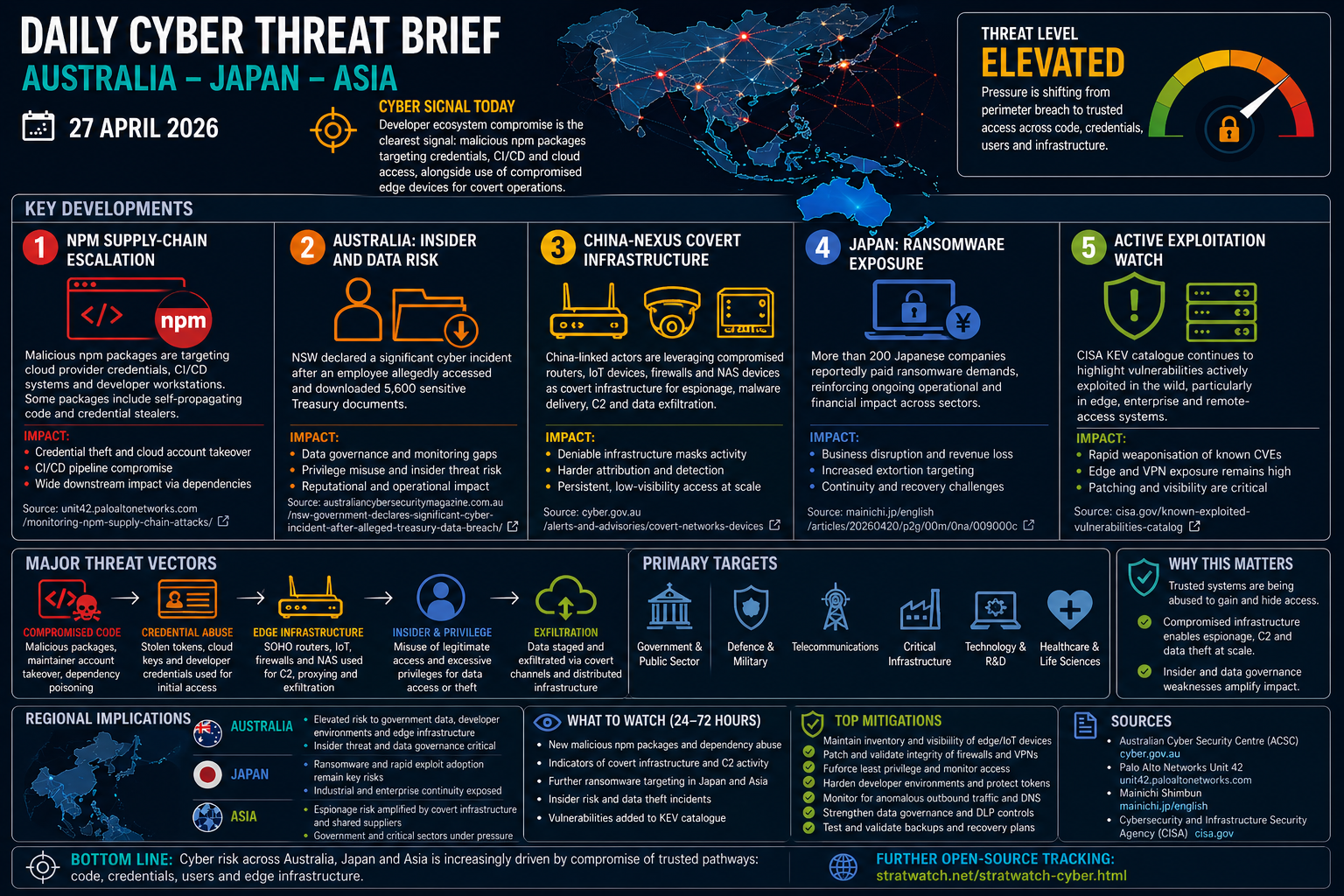
Executive Summary (BLUF)
The Indo-Pacific cyber threat environment is increasingly defined by the compromise of trusted pathways rather than traditional perimeter breaches. The most significant developments today include escalation in malicious npm supply-chain activity, a confirmed insider-driven data incident in Australia, continued use of covert infrastructure by China-nexus actors, and sustained ransomware pressure in Japan.
The central judgement is that cyber risk across Australia, Japan, and Asia is shifting toward trusted access exploitation—code, credentials, users, and infrastructure are all being leveraged to gain and maintain access. This creates a more complex defensive problem, as malicious activity increasingly occurs inside legitimate systems and trusted environments.
Operating Environment
The threat baseline remains elevated but stable. However, the nature of risk is evolving:
External intrusion is no longer the primary vector
Trusted systems (software, identity, infrastructure) are now the primary attack surface
Detection is becoming more difficult due to legitimate-path exploitation
Recent reporting highlights a convergence of:
Supply-chain compromise (developer ecosystems)
Insider risk and privilege misuse
Covert infrastructure enabling deniable operations
Continued ransomware monetisation
Together, these trends indicate a shift toward persistent, low-visibility access operations at scale.
Key Developments
Malicious npm Supply-Chain Activity (Developer Ecosystem Compromise)
Unit 42 reporting highlights ongoing malicious activity targeting npm ecosystems, including credential theft and abuse of CI/CD environments.
Tactics, Techniques, and Procedures (TTPs):
Malicious package publication and dependency poisoning
Credential harvesting from cloud providers and CI/CD systems
Self-propagating code embedded in packages
Execution via installation scripts
Systems Targeted:
Developer workstations
CI/CD pipelines
Cloud provider environments
Enterprise applications dependent on affected packages
Why it matters:
This represents scalable compromise via trusted software dependencies, enabling access across multiple organisations simultaneously.
Australia: Insider Threat and Data Governance Failure
A significant cyber incident was declared in New South Wales following alleged unauthorised access and download of 5,600 Treasury documents by an internal employee.
TTPs:
Privileged access misuse
Data exfiltration from internal systems
Lack of detection or delayed detection
Systems Targeted:
Government data repositories
Internal enterprise systems
Sensitive financial and policy data
Why it matters:
This highlights non-technical vulnerabilities:
Insider risk
Weak monitoring of privileged access
Data governance gaps
The incident reinforces that cyber risk is not solely external.
China-Nexus Covert Infrastructure (Edge and IoT Exploitation)
Advisories continue to highlight China-aligned actors leveraging compromised devices as operational infrastructure.
TTPs:
Compromise of routers, IoT devices, firewalls and NAS systems
Multi-hop proxying to obscure origin
Use of distributed infrastructure for C2 and exfiltration
Persistent low-visibility access
Systems Targeted:
SOHO routers and home-office devices
Enterprise edge infrastructure
Internet-exposed IoT environments
Why it matters:
This reflects a shift toward infrastructure-level control, enabling:
Deniable operations
Reduced attribution
Persistent access across regions
Japan: Ransomware Impact and Operational Risk
Recent reporting indicates that more than 200 Japanese firms have paid ransomware demands.
TTPs:
Credential theft and initial access
Lateral movement within enterprise environments
Data exfiltration and double extortion
Targeting of business continuity systems
Systems Targeted:
Enterprise IT environments
Industrial and operational systems
Critical business infrastructure
Why it matters:
This demonstrates:
Continued effectiveness of ransomware
Ongoing financial and operational impact
Challenges in resilience and recovery
Active Exploitation Landscape (KEV Monitoring)
The Cybersecurity and Infrastructure Security Agency Known Exploited Vulnerabilities catalogue continues to identify vulnerabilities actively exploited in the wild.
TTPs:
Rapid exploitation following disclosure
Automated scanning of exposed systems
Use of exploits for initial access
Systems Targeted:
Edge infrastructure and VPNs
Enterprise applications
Remote access systems
Why it matters:
Exploit velocity continues to compress defensive timelines, increasing exposure for organisations without rapid patching or asset visibility.
Technical and Tradecraft Observations
Trusted Pathways as the Primary Attack Surface
Attackers are exploiting:
Software dependencies
Credentials and identity systems
Legitimate user access
Insider Risk as a Critical Vulnerability
The NSW incident highlights:
Privilege misuse risks
Lack of monitoring and detection
Data governance weaknesses
Edge and Infrastructure Obfuscation
Compromised infrastructure is being used to:
Mask attacker origin
Enable multi-hop operations
Blend malicious traffic with legitimate traffic
Supply Chain as a Force Multiplier
Software supply-chain compromise allows:
Scalable access
Downstream impact across organisations
Reduced need for direct exploitation
Convergence of State and Criminal Tradecraft
State and criminal actors are increasingly using:
Credential theft
Trusted platform abuse
Infrastructure compromise
The distinction is now primarily intent.
Regional Implications
Australia
Elevated insider and data governance risk
Continued exposure in developer ecosystems
Edge infrastructure and identity vulnerabilities
Japan
Ongoing ransomware exposure
Rapid exploit adoption
Industrial and enterprise continuity risk
Asia
Persistent espionage targeting government and defence
Covert infrastructure enabling low-visibility operations
Shared dependencies increasing systemic risk
Strategic Assessment
The Indo-Pacific cyber threat environment is transitioning from intrusion-centric to trust-centric risk.
Attackers are:
Exploiting trusted systems rather than breaking into them
Leveraging infrastructure to conceal operations
Maintaining persistent access for future use
This represents preparation of the cyber environment at scale, with long-term strategic implications.
Outlook (24–72 Hours)
Key watchpoints:
New malicious npm packages and dependency abuse
Indicators of covert infrastructure activity
Insider-driven incidents and data governance failures
Continued ransomware activity
Additional KEV updates and exploit activity
Bottom Line
Cyber risk across Australia, Japan, and Asia is increasingly driven by the compromise of trusted pathways: code, credentials, users, and infrastructure. The threat is defined by persistence, scale, and reduced visibility.
Methodology / Sources
Australian Cyber Security Centre
Cybersecurity and Infrastructure Security Agency
Palo Alto Networks Unit 42
Public reporting (Australia, Japan, Asia cyber incidents)
Confidence
Moderate to High — based on multi-source alignment and consistent regional threat patterns.
