Daily Cyber Threat Report | Australia – Japan – Asia | 26 April 2026
Executive Summary (BLUF)
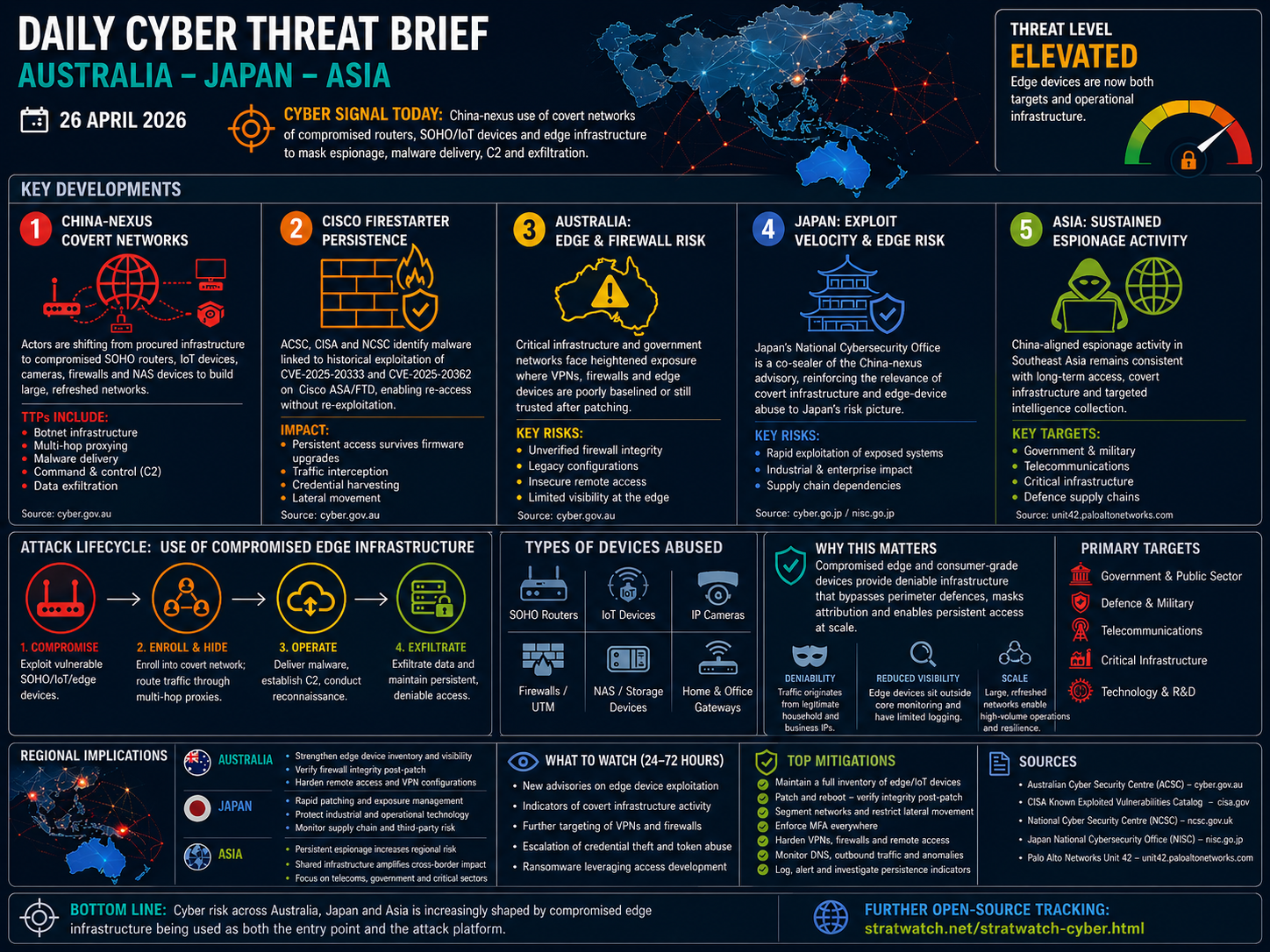
The Indo-Pacific cyber threat environment has shifted materially toward the weaponisation of compromised edge infrastructure as operational cover. Joint advisory reporting highlights China-nexus actors leveraging large-scale networks of compromised SOHO routers, IoT devices, firewalls, and NAS systems to conduct espionage, command and control (C2), malware delivery, and data exfiltration.
In parallel, new reporting on Cisco FIRESTARTER malware demonstrates that even patched network infrastructure may remain compromised, enabling re-access without re-exploitation. The convergence of these developments indicates that network edge trust assumptions are increasingly unreliable.
The central judgement is that cyber risk is no longer confined to intrusion and persistence — it now includes control of the infrastructure used to conduct operations, significantly degrading attribution, detection, and defensive response.
Operating Environment
The threat baseline remains stable in volume, but qualitatively more complex and deniable.
Recent joint advisories from Australian Cyber Security Centre and international partners (including Five Eyes and Japan’s national cyber authorities) highlight a shift in adversary behaviour:
Moving away from leased or purchased infrastructure
Toward compromised consumer and enterprise edge devices
Using these networks for multi-hop proxying, blending malicious traffic with legitimate residential IP space
Simultaneously, reporting on Cisco FIRESTARTER malware confirms that historical exploitation of network devices can create persistent footholds that survive patching or firmware upgrades, particularly in firewall and VPN environments.
This creates a threat environment where:
Detection becomes more difficult
Attribution becomes less reliable
Persistence becomes more durable
Key Developments
China-Nexus Covert Networks of Compromised Devices
A joint advisory warns that China-aligned actors are leveraging large-scale networks of compromised devices as operational infrastructure.
Tactics, Techniques, and Procedures (TTPs):
Compromise of SOHO routers, IoT devices, IP cameras, firewalls, NAS systems
Multi-hop proxying to mask origin of operations
Use of botnet-style infrastructure for resilience and redundancy
Command and control (C2) through distributed nodes
Data exfiltration routed through compromised infrastructure
Systems Targeted:
Consumer-grade networking devices
Enterprise edge infrastructure
Internet-exposed IoT devices
Hybrid enterprise/home-office environments
Why it matters:
This represents a shift from compromise for access to compromise for infrastructure control. Attackers are building persistent, deniable networks that support long-term operations at scale.
Cisco FIRESTARTER Malware Persistence
Advisory reporting identifies FIRESTARTER malware affecting Cisco ASA and Firepower Threat Defense (FTD) devices.
Linked vulnerabilities:
CVE-2025-20333
CVE-2025-20362
TTPs:
Initial exploitation of known vulnerabilities
Implantation of persistent malware within device firmware or configuration layers
Re-establishment of access without re-exploitation
Credential harvesting and traffic interception
Potential lateral movement into internal networks
Systems Targeted:
Cisco ASA firewalls
Cisco Firepower Threat Defense devices
Enterprise VPN and perimeter infrastructure
Why it matters:
This demonstrates that patching alone may not remove compromise, particularly for network infrastructure. It introduces a requirement for post-compromise validation and forensic verification.
Australia: Elevated Edge and Firewall Risk
Australia’s threat posture is directly impacted by both developments above.
Observed risks:
Compromised firewalls still trusted after patching
Limited visibility into edge devices
Weak baselining of VPN and remote access infrastructure
TTP overlap:
Credential harvesting via compromised edge systems
Persistence within firewall and VPN infrastructure
Abuse of trusted network paths
Systems at risk:
Government networks
Critical infrastructure operators
Healthcare and enterprise environments
Why it matters:
Australia faces systemic exposure at the edge, where compromise may not be visible through traditional monitoring.
Japan: Covert Infrastructure and Exploit Velocity
Japan is a co-sealer of the China-nexus advisory through its national cybersecurity authorities, reinforcing the relevance of this threat model.
Risk factors:
Rapid exploitation of exposed enterprise systems
Increasing relevance of compromised infrastructure as attack cover
Exposure of industrial and operational technology environments
TTPs:
Exploitation of exposed systems
Use of covert infrastructure for access and persistence
Supply chain and third-party dependency targeting
Why it matters:
Japan’s cyber risk is increasingly shaped by both exploit speed and infrastructure concealment, increasing the difficulty of defensive response.
Asia: Sustained Espionage Enabled by Covert Infrastructure
Across Southeast and broader Asia, China-aligned activity continues to target:
Government networks
Defence and military systems
Telecommunications infrastructure
Critical supply chains
TTPs:
Long-term persistence
Use of covert infrastructure for C2 and exfiltration
Custom malware and backdoors
Targeted intelligence collection
Why it matters:
Covert infrastructure enables persistent, low-visibility espionage operations, reducing detection and increasing strategic impact.
Technical and Tradecraft Observations
Edge Infrastructure as Both Target and Platform
Edge devices are no longer just entry points — they are now operational platforms supporting attack infrastructure.
Persistence Beyond Patching
FIRESTARTER demonstrates that compromise can survive patching, requiring:
Configuration validation
Firmware integrity checks
Full device rebuild in some cases
Identity and Traffic Visibility Degradation
Use of residential and compromised infrastructure:
Obscures attacker identity
Reduces effectiveness of IP-based blocking
Complicates attribution
Multi-Hop and Distributed Operations
Attackers are increasingly:
Routing traffic through multiple compromised nodes
Using distributed infrastructure for resilience
Blending malicious traffic with legitimate flows
Convergence of Infrastructure and Access Tradecraft
The same infrastructure now supports:
Initial access
Command and control
Data exfiltration
Espionage operations
Regional Implications
Australia
Immediate need to reassess trust in edge devices
Increased risk in firewall/VPN infrastructure
Critical infrastructure exposure heightened
Japan
Exposure to both rapid exploitation and covert infrastructure use
Industrial and operational environments at risk
Asia
Persistent espionage enabled by deniable infrastructure
Shared dependencies amplify cross-border risk
Strategic Assessment
The Indo-Pacific cyber threat environment is entering a phase where infrastructure control is as important as system compromise.
Attackers are:
Building resilient, deniable networks
Exploiting trust in edge systems
Maintaining long-term access
This represents a shift toward strategic positioning within the cyber domain, where access is sustained and leveraged over time rather than used immediately.
Outlook (24–72 Hours)
Key watchpoints:
Further advisories on edge-device compromise
Indicators of covert infrastructure activity
Additional reporting on firewall/VPN persistence
Continued credential theft and token abuse
Ransomware leveraging established access
Bottom Line
Cyber risk across Australia, Japan, and Asia is increasingly shaped by compromised edge infrastructure being used as both the entry point and the attack platform. This reduces visibility, weakens attribution, and enables persistent operations at scale.
Methodology / Sources
Australian Cyber Security Centre
Cybersecurity and Infrastructure Security Agency
National Cyber Security Centre
National center of Incident readiness and Strategy for Cybersecurity
Palo Alto Networks Unit 42
Confidence
High — based on coordinated multi-national advisories and consistent threat reporting across allied cybersecurity agencies.
